
Options Strategy: A Professional, Probability-Based Approach

Options are not strategies by themselves.
They are tools — and tools only work when used in the right context.
Most retail traders approach options strategies backwards: they start from the structure (iron condor, spread, straddle) and hope the market fits the strategy.
Professional traders do the opposite.
They start from market conditions, probability, volatility, and risk, then select the appropriate structure.
This article outlines the professional framework used to approach options strategies — without hype, without prediction, and without shortcuts.
The Core Problem With Retail Options Strategies
Retail education focuses on what a strategy is.
Professionals focus on when and why a strategy should be used.
Common retail mistakes:
Choosing strategies based on payoff shape alone
A beautiful P&L diagram means nothing if the underlying conditions don't support it. Retail traders fall in love with the visual symmetry of iron condors and or butterflies without asking whether the current volatility environment makes those structures viable.
Ignoring volatility regimes
Selling premium in low IV environments or buying options in high IV without adjustment is gambling with negative expectancy. Volatility is not background noise — it's the core variable that determines whether a structure makes sense.
Treating probability as a secondary metric
Pop (probability of profit) gets marketed as the main number, but it's often misleading. A 70% PoP strategy with unlimited risk is worse than a 50% PoP strategy with defined, asymmetric payoff.
Confusing direction with edge
Directional bias is not an edge. The market doesn't care about your opinion. Edge comes from volatility mispricing, time decay mechanics, and probability distribution — not from predicting price movement.
Managing risk after the trade is opened, not before
Risk is defined at entry, not during panic. If you don't know your max loss, your exit conditions, and your portfolio impact before placing the trade, you're not trading — you're reacting.
An options strategy without context is random exposure.
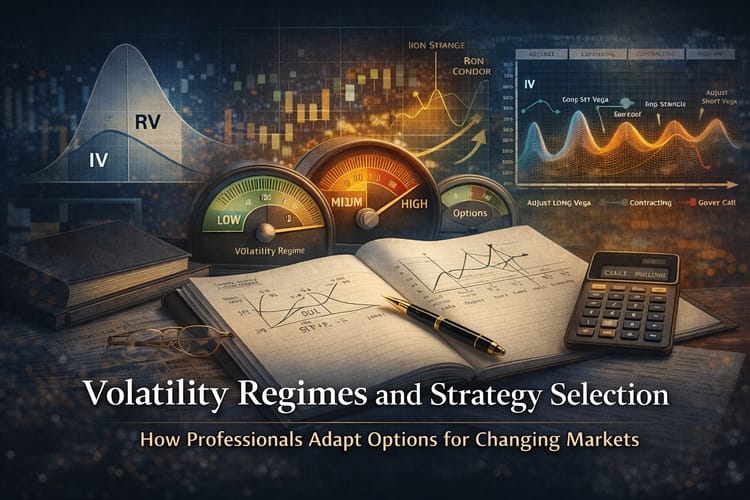
Strategy Selection Comes After Market Regime
Before thinking about any structure, professionals ask:
Is volatility high or low relative to itself?
Absolute IV levels mean nothing. A 20 VIX can be "high" if it was 12 last month. A 35 VIX can be "low" if it was 50 two weeks ago. Context matters more than the number.
Is volatility expanding or contracting?
Expanding volatility punishes premium sellers and rewards option buyers. Contracting volatility does the opposite. You can't use the same structures across both regimes and expect consistent results.
Is the market trending, ranging, or transitioning?
Trending markets favor directional structures with skew. Ranging markets favor non-directional, theta-positive positions. Transitional markets require adaptive, delta-neutral approaches. Mismatching structure to regime is the fastest way to lose money.
Where is risk concentrated across greeks?
Is your portfolio long gamma and short theta? Short vega and long delta? You need to know your net exposure before adding another position. Every new trade changes the portfolio — strategy selection must account for that.
Only after answering these questions does a strategy make sense.
Strategy is a response to conditions — not a bet on direction.
Probability Over Prediction
Retail traders try to predict price.
Professionals build strategies where probability is structurally in their favor.
Key concepts professionals focus on:
Probability of profit vs payoff asymmetry
A strategy with 80% PoP where you risk $5 to make $1 is a trap (EV = -$0.20). A strategy with 40% PoP where you risk $1 to make $3 might be excellent (EV = +$0.60). Expected value matters more than win rate. Professionals calculate EV before opening a trade.
Distribution of outcomes, not best-case scenarios
Retail traders imagine the ideal scenario. Professionals model the range of likely outcomes, including the worst case. They size positions based on the tail, not the mode.
Time decay as a strategic component
Theta is not free money. It's compensation for taking on gamma and vega risk. Professionals understand that selling theta requires accepting that occasionally, markets will move faster than time decay can offset. They size accordingly.
Volatility mispricing, not price direction
The real edge in options is finding where implied volatility diverges from realized volatility, or where term structure is inverted, or where skew is mispriced. These edges are statistical, not directional.
A strategy with a 70% probability of success but poor risk control is not professional.
A strategy with controlled risk and repeatable expectancy is.
Options Structures Are Tools, Not Edges
Iron condors, credit spreads, butterflies, calendars — none of them are edges by default.
They become effective only when:
Aligned with volatility conditions
Selling iron condors in low IV is structurally disadvantaged. Buying long straddles in high IV with rapid contraction is suicide. The structure must fit the regime.
Sized correctly
Position sizing is not about how much you want to make. It's about how much you can afford to lose relative to your total portfolio. Professionals size to survive outliers, not to maximize single-trade profit.
Managed according to predefined rules
No discretion during live trades. Exit rules are set before entry: time stops, delta thresholds, profit targets, loss limits. Emotional management is risk management.
Integrated into a portfolio-level risk framework
A single position might be "safe" in isolation but catastrophic when combined with other positions. Professionals manage greeks at the portfolio level, not the trade level.
The edge is not the structure.
The edge is the process.
Risk First, Always
Professional options strategy design starts with risk, not reward.
That means defining before entry:
Maximum acceptable loss
Not the max theoretical loss on the payoff diagram — the actual dollar amount you're willing to lose on this trade as part of your portfolio. If you can't state it clearly, don't open the position.
Exit conditions (time-based, volatility-based, price-based)
"I'll exit when I feel uncomfortable" is not a plan. Exit rules must be objective: "Exit at 21 DTE regardless of P&L," "Exit if delta exceeds 0.25," "Exit if IV rank drops below 20."
Impact on portfolio greeks
Adding a bearish position when your portfolio is already net short delta compounds risk, it doesn't hedge it. Know your greeks before, during, and after the trade.
Margin efficiency
Margin is a tool, not a weapon. Using 90% of your buying power to deploy one strategy leaves no room for adjustment, hedging, or opportunity. Professionals operate below 50% margin utilization.
Worst-case scenarios
Flash crash. Gap open. Volatility spike. Professionals don't hope these won't happen — they plan for them. Stress testing is mandatory, not optional.
If you cannot define risk clearly, you do not have a strategy — you have a guess.
From Isolated Trades to Strategic Thinking
Retail traders think in individual trades.
Professionals think in systems.
A professional options strategy:
Is repeatable
One great trade is luck. One hundred trades with consistent expectancy is a system. Repeatability requires rules, not intuition.
Is statistically grounded
Professionals backtest, forward test, and track every trade. They know their win rate, average win, average loss, max drawdown, and recovery time. Gut feel doesn't scale.
Fits within a broader portfolio
An options strategy is not a standalone bet. It's a component of a diversified portfolio that includes cash, hedges, and other positions. The goal is portfolio-level risk-adjusted return, not single-trade heroics.
Has defined rules
Entry criteria, exit criteria, position sizing, adjustment triggers — all documented. No discretion. The system is the strategy.
Accepts drawdowns as part of the distribution
No strategy wins 100% of the time. Professionals accept that drawdowns are inevitable and plan capital allocation to survive them. The goal is not to avoid losses — it's to keep them contained.
Consistency comes from process, not from individual wins.
Related Research
- Why Most Retail Options Strategies Fail
- Volatility Regimes and Strategy Selection
- Probability of Profit vs Expected Value
- Why Directional Bias Is Not an Edge
Tools That Support Strategy Design
Professional strategy selection requires tools, not intuition.
On Nardaggio you'll find tools designed to support this process:
- Position sizing models
- Volatility analysis dashboards
- Options payoff visualization
- Risk exposure tracking
Final Thought
Options reward discipline, structure, and humility.
There are no universal strategies.
There are only frameworks that adapt to conditions.
If you want to approach options the way professionals do, strategy is where everything begins — but only when it's grounded in probability, risk, and context.
If you want to deepen your understanding of professional options strategy and market structure, join the newsletter.
Member discussion